Salomon Peak, U.S. military briefer
The SwarmSalomon Peak, U.S. military briefer, is a major in the U.S. military whose role at the Allied Emergency Committee is to translate a rapidly expanding ecological crisis into a military and international-security briefing. At Chateau Whistler, he presents satellite images and figures linking lost boats, anomalous worms, destabilized methane hydrates, and the Norwegian continental-slope disaster. His composed delivery gives the committee’s emergency a legible scale, but moments of fear and irritation show how little certainty that presentation can offer.
Identity and Position
Peak first appears among uniformed men arriving at the hotel that houses the crisis committee. His name badge identifies him as Peak, and his insignia mark him as a U.S. military general; the subsequent account identifies him as Major Salomon Peak. He is tall and has Ethiopian features. These details establish him as a senior military presence in a gathering where scientific interpretation and military authority increasingly overlap.
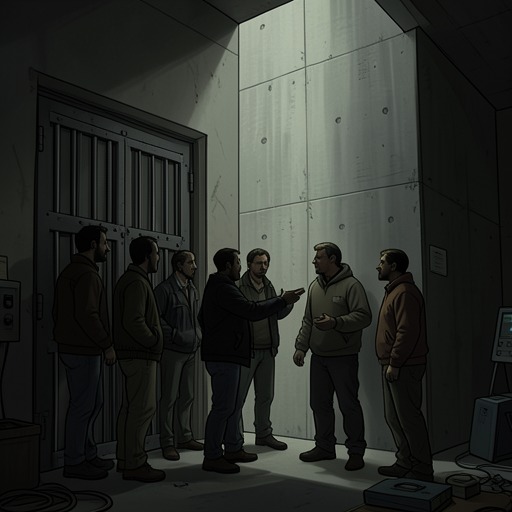
The hotel management has placed committee members in its best accommodation. Peak is staying in a junior suite one floor below the gold executive suites, although he would have preferred an unadorned single room and cares little for luxury. As he walks to meet Judith Li, he runs through arrangements for the presentation. The setting makes his task part of the committee’s larger operation: hotel suites have been converted into offices, soldiers guard doors, and briefings take place inside a temporary headquarters.
The Whistler Briefing
Li introduces Peak as the person who will continue the presentation, handing the meeting over to him. He begins with a satellite image of a coastline and identifies Huanchaco as a starting point for the account. In a few days, twenty-two fishermen disappeared there, despite calm weather; some boats were later found adrift, while sports boats, motor yachts, and small sailing boats subsequently vanished as well. Sometimes debris was recovered, but often nothing was found. The place names and missing vessels turn an apparently local series of incidents into the opening evidence of a pattern.
Peak then broadens the scale of the briefing to the northern European disaster. The North Sea had been a major fossil-fuel region, with roughly 450,000 barrels of oil extracted each day and large shares of European oil and natural-gas reserves nearby. Its industrial infrastructure was destroyed within hours. Peak recites initial estimates of two or three million dead, with at least as many more injured or homeless, in a delivery compared to a weather report. The calm manner of the recitation contrasts with the magnitude of the figures: catastrophe has become information that the committee must process and act upon.
Rather than presenting the worms as a complete explanation, Peak states that the scale of the slope collapse remains unresolved. He reports that billions of polychaete worms had worked with bacteria and spread across the continental slope, destabilizing methane hydrates. Sigur Johanson and researchers at the GEOMAR Centre in Kiel, he says, believe the committee does not yet have the full story. The worm invasion is consequential, but it does not by itself account for a catastrophe of that magnitude; the wave was only the most visible part of a wider problem.
The briefing grows more alarming when Peak says that large quantities of methane have escaped from the seabed. He compares the release with the earlier sinking of the Juno, describing the amount released during the underwater slide as a million times greater. Scenarios in which the world’s remaining underwater methane reserves escaped in a similar way, he warns, would fatally destabilize the atmosphere. He then reports that worms have been found in both the Atlantic and Pacific, including along continental slopes off North and South America, western Canada, and Japan. His sequence moves from a particular disaster to the possibility of a threat distributed across oceans.
Authority Under Pressure
Peak’s presentation is meant to supply the military committee with a coherent account, but the evidence also exposes the limits of that account. The satellite material shows a vessel under surveillance, and the subsequent briefing identifies methane release from the seabed; neither observation resolves what caused the wider events. Peak can state what has been seen, compare the risks with known scenarios, and make the danger intelligible to the room, but he cannot supply a settled explanation.
That gap becomes personal when the journalist Vanderbilt challenges the official account and proposes that the mutations and attacks are deliberate acts of terrorism. Johanson bluntly calls Vanderbilt crazy. Peak, meanwhile, is described as flustered: military officers do not usually express criticism or doubt in that tone. He does not reject criticism as such, but resents being challenged when he cannot restore his authority simply by issuing an order. His response exposes a practical problem behind the committee’s command structure: he must manage scientists whose questioning cannot be disciplined like that of soldiers.
Even as he presents frightening projections, Peak’s own fear becomes apparent before he announces that the worms have spread across the Atlantic and Pacific. The pause and the room’s silence register the report’s force without converting it into certainty about the organisms’ purpose. His role is therefore not that of an all-knowing military interpreter. He is a briefer conveying what is known, what remains unexplained, and what the implications could be if the worst scenarios prove possible.
The Committee’s Changing Response
The committee’s public and military language changes as the crisis worsens. Earlier, Judith Li had told viewers that the response to animal attacks should avoid violence while investigators sought their cause, and that people should stay out of the water. At Chateau Whistler, she tells the assembled specialists that the meeting’s location keeps the committee away from the media, says its activity is publicly described as an exercise, and requires members to sign a declaration of silence. Peak’s briefing follows that insistence on secrecy, but its subject matter makes the stakes of withholding information plain: the presentation concerns mass casualties, disrupted energy supplies, and danger far beyond the original disaster.
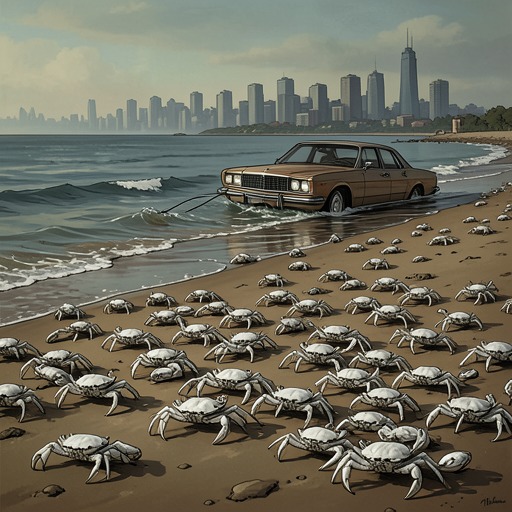
Later, Li reports that New York has been isolated and that crab sightings in Washington have been confirmed. She describes plans to quarantine Washington, surround key coastal cities with troops armed with flamethrowers, and develop an antitoxin. She also rejects the use of submersibles and dive robots because their communications are being lost or severed. When the discussion turns to response at sea, Li announces plans to use SURTASS LFA against whales, arguing that a force controlling the animals must be answered in kind. These are Li’s measures, not Peak’s orders, but they define the institutional escalation surrounding the intelligence he has helped present: from investigation and caution toward quarantine and force.
Narrative Role
Peak functions as a military briefer at the point where the novel’s separate marine anomalies become a global security problem. His presentation links missing vessels in Peru to methane release and worm discoveries across multiple ocean basins, while the figures he recites give the North Sea disaster a human and economic scale. This is not a resolution of the mystery. Instead, the briefing makes its incompleteness part of the crisis: the worms explain some destabilization, but the cause of the full catastrophe remains unknown.
The contrast between Peak’s measured recitation and his private alarm, and between military authority and his inability to silence legitimate doubt, keeps the briefing from becoming a simple declaration of control. The committee can assemble images, reports, and projections; it cannot yet command the deep sea or fully explain its changes. Peak’s importance lies in making that unstable boundary visible: he gives the emergency a military vocabulary, but the evidence he presents also shows that the threat exceeds what the briefing can master.